All posts in News

WSPPN News

Posted: May 27, 2014

WASHINGTON –The U.S. Environmental Protection Agency (EPA) announced today the first-ever Energy Star label for clothes dryers. If all residential clothes dryers sold in the U.S. meet these new requirements, the utility cost savings will grow to more than $1.5 billion each year and more than 22 billion pounds of annual greenhouse gas emissions would be prevented. Informed by extensive input from manufacturers, retailers, the U.S. Department of Energy and environmental groups, the new specifications will recognize a selection of highly efficient electric, gas, and compact dryers that will use approximately 20% less energy than what is required by the minimum efficiency standards effective in 2015. In 2013 alone, Americans, with the help of Energy Star, saved $30 billion on their utility bills and prevented greenhouse gas emissions equal to those of 38 million homes.

“The addition of clothes dryers expands the range of Energy Star products to include one of the most energy-intensive home appliance not yet covered by the program,” said U.S. EPA Administrator Gina McCarthy. “Working with industry on innovative approaches to address our changing climate, we are helping consumers select more energy efficient appliances, save money and reduce greenhouse gas emissions.“
Read more

Posted: May 14, 2014
Source: U.S. Energy Information Administration

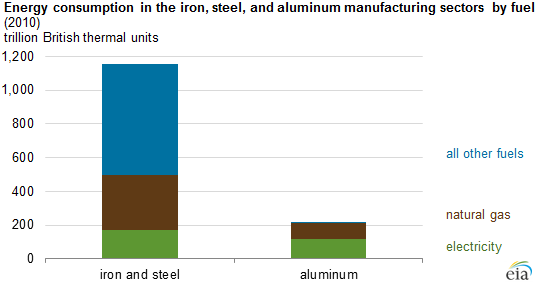
graph of energy consumption in the iron, steel, and aluminum manufacturing sectors by fuel, as explained in the article text

Source: U.S. Energy Information Administration, Manufacturing Energy Consumption Survey

The production of iron, steel, and aluminum is a highly energy-intensive process, accounting for 10% of total manufacturing energy use. The use of recycling in the manufacturing process of these metals has been a main driver of improvements in energy efficiency within the industry.
Read more

Posted: May 12, 2014
Source: Environmental Leader.com

General Motors’ fleet of fuel cell vehicles has passed 3 million miles of hydrogen-powered, real-world driving, avoiding 157,894 gallons of gasoline consumption, GM estimates.

Some individual vehicles have accumulated more than 120,000 miles.

The fleet of Chevrolet Equinox Fuel Cell vehicles is part of GM’s 119-vehicle Project Driveway program, which launched in 2007.
Read more

18th Annual Green Chemistry & Engineering Conference

Hosted by the American Chemical Society Green Chemistry Institute®, the 18th Annual Green Chemistry and Engineering Conference (GC&E) is June 17-19, 2014, in Bethesda, MD.

GC&E invites scientists, decision-makers, students, and advocates to come together, compare findings, and discuss the science of the future. Over three days of programming featuring more than 25 technical sessions, you can explore green chemistry and engineering advancements, while attending poster sessions, the green exhibit hall, networking events, and keynote lectures. Other special events include the GC&E Student Workshop (held on June 16th), a Careers Workshop, and a 2014 GC&E Business Plan Competition.

More information

Posted: April 25, 2014
Source: Environmental Leader.com

Waste Management’s compressed natural gas trucks cut greenhouse gas emissions by 25 percent and reduce particulate matter by 90 percent, Automotive Fleet reports.

The waste and recycling company earlier this month added six CNG trucks to its fleet in Chico, Calif. “We see an average annual reduction of 22 metric tons of greenhouse gases and 8,000 gallons of diesel with the CNG trucks,” district manager Ryan West tells the publication.

The company also uses route optimization software and its truck engines are programmed to shut down automatically after idling for five minutes to further cut emissions and fuel costs.

The company has used natural gas for heavy-duty trucks since the 1990s. Waste Management operates more than 2,200 alternatively fueled vehicles and says it has the largest fleet of natural gas collection trucks in North America.

Last year, Waste Management began building a facility to create pipeline-ready natural gas from its Milam Landfill in Fairmont City, Ill. At the time, the company said it expects it to begin delivering gas to the pipelines in late summer 2014.

Posted: April 23, 2014
Source: Fuel Fix.com

HOUSTON —  Navy researchers say they have turned seawater into fuel that could power military vehicles for less than $6 per gallon.

The researchers announced this month that the seawater-based fuel successfully powered a remote-controlled model jet with a standard two-stroke internal combustion engine. Carbon dioxide and hydrogen gas extracted from Gulf of Mexico water were converted  into liquid hydrocarbon fuel using gas-to-liquid technology. The renewable fuel mirrors its petroleum-based counterpart and could be used in standard military engines.

“The potential payoff is the ability to produce JP-5 fuel stock at sea, reducing the logistics tail on fuel delivery with no environmental burden and increasing the Navy’s energy security and independence,” said Naval Research Laboratory chemist Heather Willauer in a written statement. ”This is the first time technology of this nature has been demonstrated with the potential for transition from the laboratory to full-scale commercial implementation.”

The fuel would cost $3 to $6 per gallon and would be commercially viable within 10 years, with sufficient research funding, according to the Naval Research Laboratory.

The scientists now are working to scale up the technology to increase fuel output. The ability to power military ships and aircraft with seawater-based fuel would be revolutionary. In fiscal year 2011, the primary fuel supplier to the Navy delivered nearly 600 million gallons to power the vessels.

Posted: April 23, 2014
Source: Fuel Fix.com

HOUSTON — The U.S. exported an average 3.5 million barrels per day of petroleum products last year, the U.S. government reported Tuesday, a 10 percent increase from 2012.

The Energy Information Administration also noted that in December, the U.S. exported 4.3 million barrels per day of petroleum products, marking the first time those exports exceeded 4 million barrels per day in one month.

Refining: US exporting a ‘tidal wave’ of gasoline, other fuels

Distillate fuel exports – which include diesel fuels and fuel oils — reached more than 1.1 million barrels per day, an increase of 110,000 barrels per day over 2012.  Distillates destined for Central America and South America saw the biggest increase. That region was already the largest destination of U.S. distillate fuel.

Propane exports increased more than 75 percent to 300,000 barrels per day and half went to Central America and South America.

Gasoline exports increased 9 percent to 550,000 barrels per day, with exports to Africa, Mexico and Central and South America all on the rise. The U.S. also set a monthly gasoline export record in December, when it shipped 770,000 barrels abroad daily.

Crude exports: Houston fills with oil that can’t be shipped out

Still, despite the export boom, the nation imported  2.1 million barrels per day of petroleum products in 2013, though that figure is on the decline.

While the Gulf Coast is a net exporter of gasoline, the East Coast imports a substantial amount from Europe and Canada, according to the EIA. The East Coast also depends on imports of distillate and propane during cold winters when regional production and shipments from other parts of the U.S. still aren’t enough to meet demand.

Posted: April 23, 2014
Source: Reuters

With California facing its worst drought in a century, state officials have fast-tracked first-in-the-nation water efficiency standards for new toilets, urinals and faucets, an action expected to save about 8.2 billion gallons of water the first year while cutting energy use and greenhouse gas emissions.

The draft standards, released late last week, would prohibit the sale of appliances in California that do not meet proposed standards, which are expected to go into effect in 2016.

The standards would require that toilets use no more than 1.28 gallons per flush instead of the current limit of 1.6 gallons per flush.

They would limit urinals to a half a gallon of water per flush, half of what is currently allowed.

Lavatory faucets would have a maximum water use level of 1.5 gallons per minute under the proposed standards, down from the current limit of 2.2 gallons per minute.

California Energy Commission Chair Robert Weisenmiller hopes that California’s standards will serve as a model for other parched states and even the federal government as policymakers grapple with how to conserve water as climate change puts a dent in supplies.
Read more

Posted: April 23, 2014
Source: Environmental Leader.com

For about half of Americans, recycling starts and ends in the kitchen. A new survey shows that 72 percent of consumers consistently recycle in the home, but only about half do so in rooms beyond the kitchen.

The 2014 Cone Communications Recycling in the Home Survey shows there are several key barriers to expanding recycling in the home, including the lack of room-specific recycling bins and clear product labeling.

Americans are willing to recycle, but good intentions aren’t enough, according to the survey’s authors. They say that not having a recycling bin in each room prevents consumers from recycling more. Nearly one-in-five (17 percent) would recycle more if they had better or more convenient recycling bins throughout the house. The majority (56 percent) of recyclers keeps bins in the kitchen.

Bins aren’t the only roadblock to recycling. Consumers also fault not knowing what products or packaging are recyclable and the amount of space recycling requires as additional factors in favor of tossing recyclables in the trash, the survey revealed.

Of the consumers who do recycle, the majority does so because of a genuine concern for the environment (42 percent). Just 10 percent of Americans recycle solely because it is mandatory in their communities.